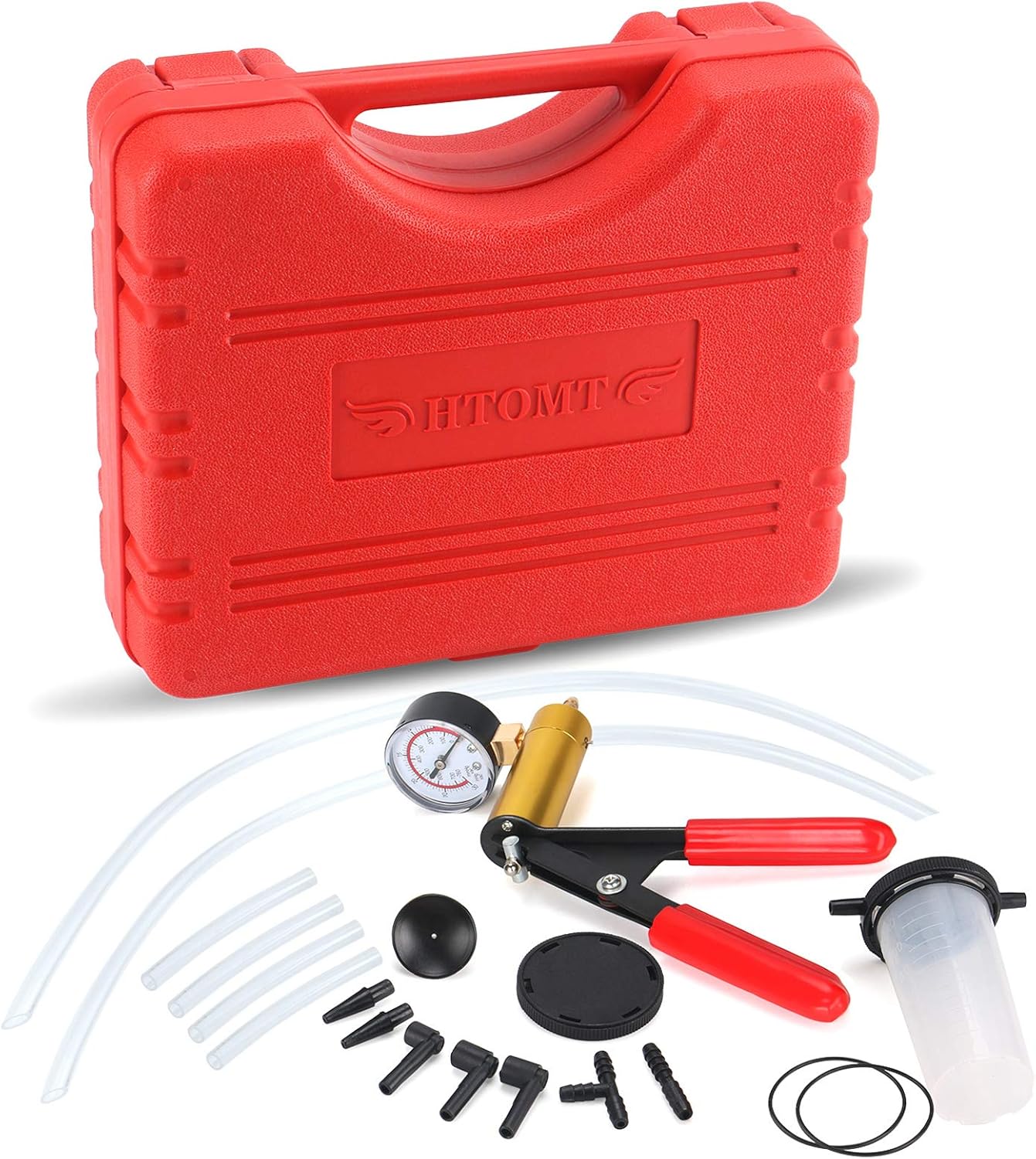
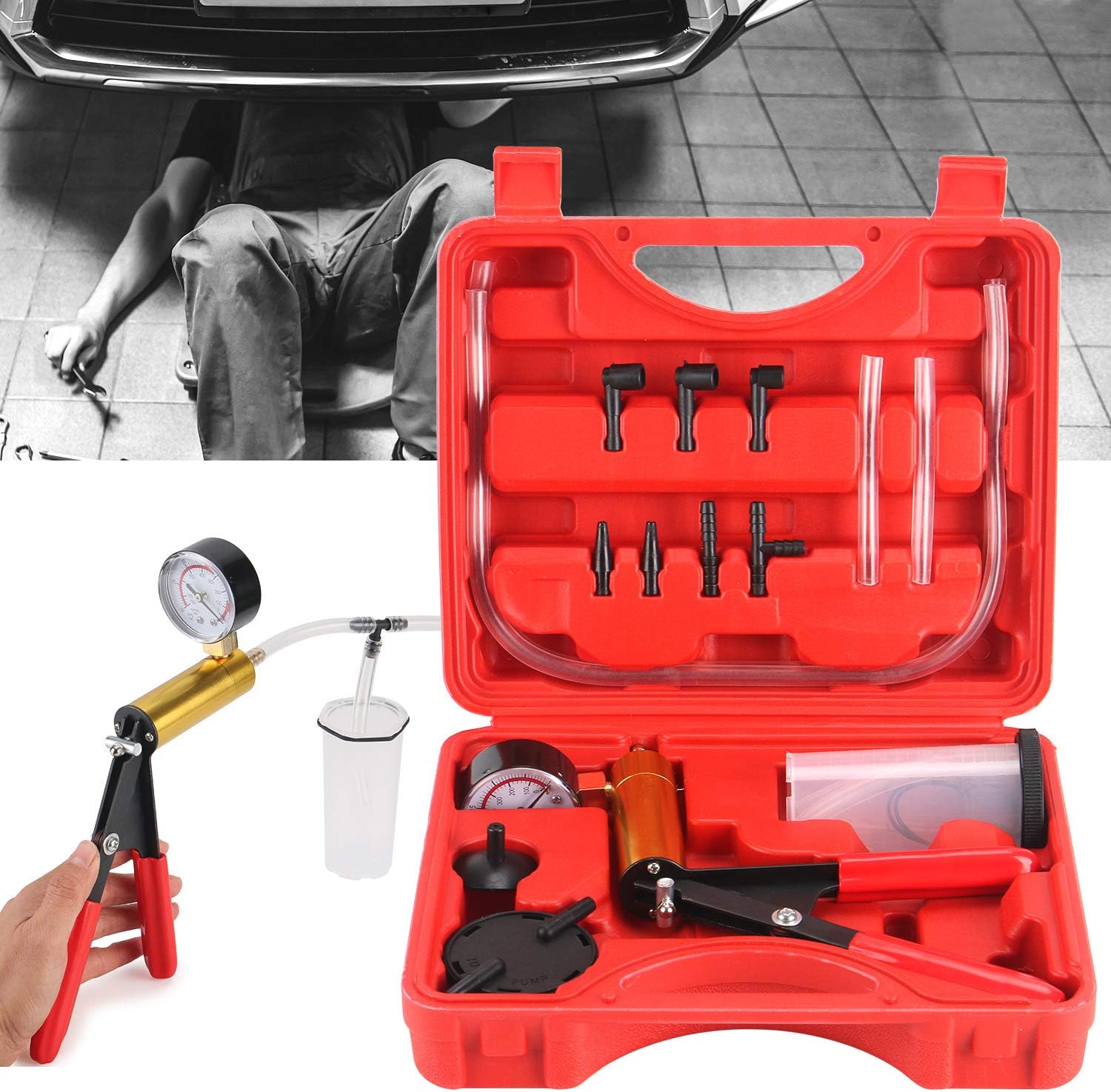
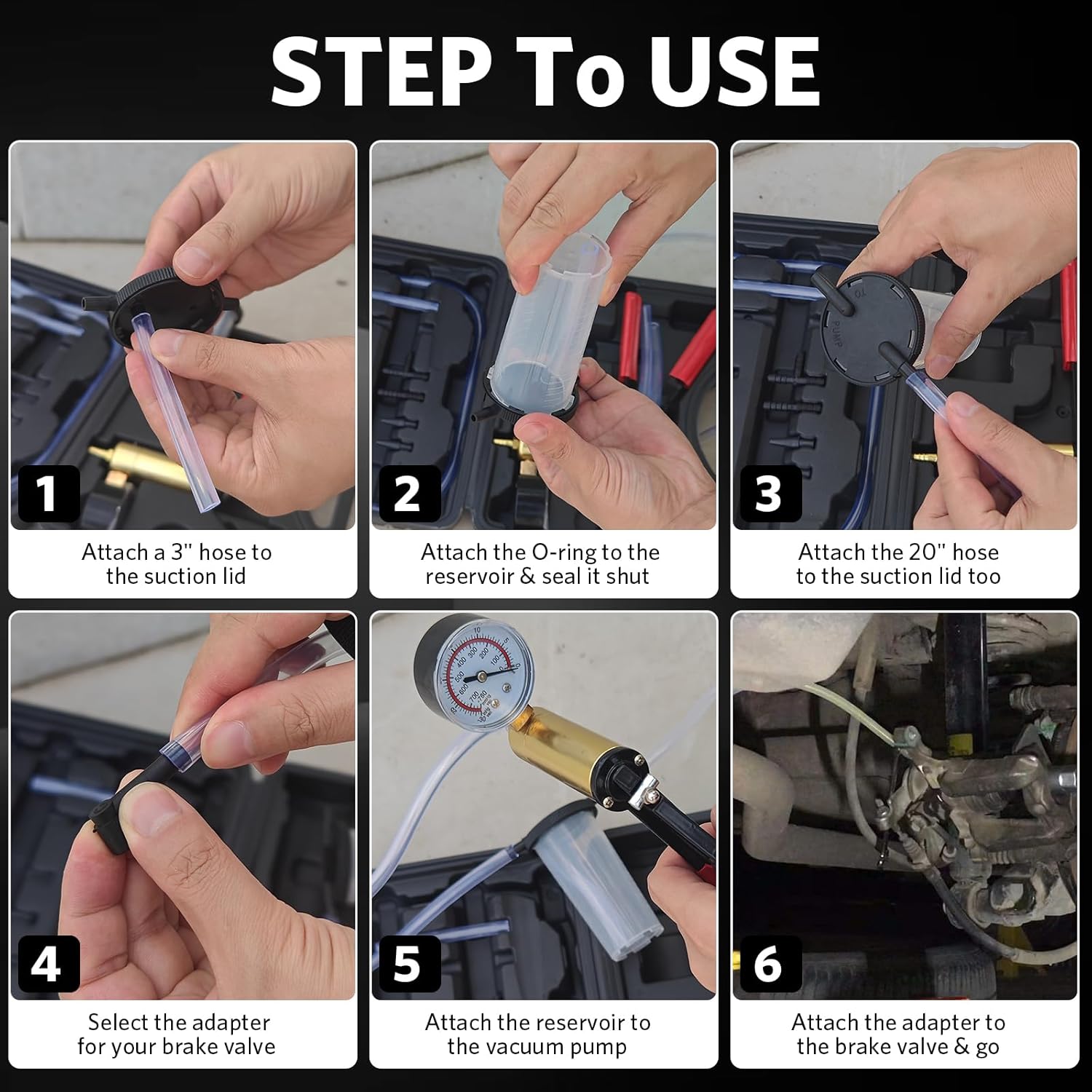
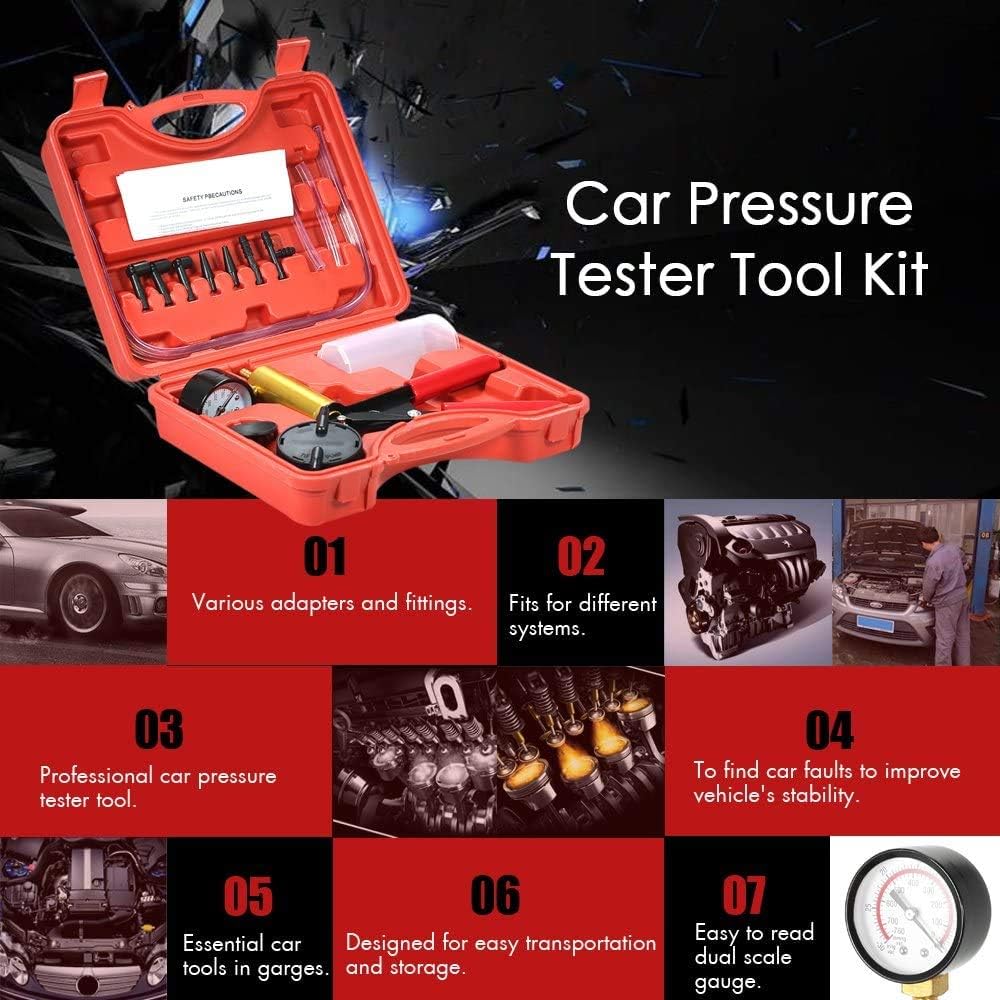
2 in 1 Brake Bleeder Kit Hand held Vacuum Pump Test Set for Automotive with Protected Case,Adapters,One-Man Brake and Clutch Bleeding System(Red)
$ 8.23
11/30/22In a previous revision of this review, I unfairly cast doubt on the effectiveness of this kit, because the brakes became spongy when they got hot (by my standards) as a result of exiting a freeway onto a fairly long downhill stretch, at the end of which I had to take a right onto a side street. So, the brakes had to absorb much more energy in a shorter amount of time than they had since I had changed the fluid. Later, after they had an opportunity to cool down, the problem disappeared. For a while, I suspected that there was excessive water in the fluid, and that the water had boiled, but after testing the fluid with a brake fluid tester (appx. $15 from Amazon), I realized that the fluid was fine, and concluded that the master cylinder was the problem. Brake fluid becomes much less viscous as it heats up, and more likely to leak past seals. The old brake fluid had probably ruined the old seals, and then when I was experimenting with bleeding methods and pushed the pedal to the floor (which experts discourage, as I learned later), the seals were probably ruined further by being dragged across a rough, unused section of the master cylinder.Fortunately, by the time the fluid heated up, and the brakes became spongy, I was pulling into a parking space with an empty space in front of me, and didn’t hit anything despite overshooting the front of the space. But the consequences could have been disastrous.So, the vacuum-pump bleeder wasn’t the problem. However, I decided that I’d rather not put up with the air-leakage problem of the vacuum-pump method, and to instead use the pressure method, which is recommended in a Fiat-Chrysler safety recall notice from August 2018 entitled Dealer Service Instructions for: Safety Recall U86/NHTSA 18V-523 Low Brake Pedal which includes the following statement:”NOTE: The bleeding procedure described in this recall may be used to remove air from the brake system. PRESSURE BLEEDING IS RECOMMENDED if pressure bleeding equipment is available. If pressure bleeding equipment is available, follow the manufacturer’s directions for proper use.”However, if you don’t mind air pockets in the bleeder-hose, or using some technique to reduce the air-leakage through the bleeder-screw’s threads (simply pressing on the bleeder-screw might help, without causing other problems, but all of the other methods I’ve seen supposedly risk contaminating the fluid, and some of them have other problems), you would probably find the vacuum-pump method satisfactory. You would just pump until the fluid color changes from dark to clear, or if the “old” fluid is as clear as the new fluid, you’d just pump out enough fluid to ensure that the old fluid has been removed (a cup might be overkill, but I’d rather waste a little fluid than risk leaving the older fluid in the system).Here’s an earlier revision (with minor clarifications), which is still valid and contains some useful information:============================The pump works well, although all of the bleeder-screw fittings were too large for my car’s bleeder screws, so I connected the hose directly to the front bleeder screws. For the rear bleeder screws, I used a small hose from a $5 bleeder kit (which I ordered before this one and thought was a total waste), and used one of the conical adapters supplied with the pump to connect the small hose to the larger hose.All of my car’s bleeder screws were clogged, and the pump was unable to pull any fluid through them until I either replaced them or unclogged them with a piece of wire. If a bleeder screw is clogged and fluid runs out when you remove it, you’ll have to get a replacement bleeder screw, or something to plug the bleeder port while you unclog the screw. (I’ve seen plastic bleeder-port plugs on the internet.) Bleeder screws have fine threads, and equivalent bolts are uncommon. The front and rear screws aren’t necessarily the same.Because the pump creates a vacuum in the brake system, some air will get pulled in through the bleeder-screw threads and into the bleeder-port (see the relevant diagram [1], which I posted along with this review), where it is pulled out along with fluid coming from the brake cylinder, creating large air pockets in the fluid in the bleeder hose and giving a false impression that there’s a lot of air in the brake system.I didn’t bother to seal the bleeder screws, and just ignored the air pockets in the bleeder hose and pumped until the new fluid started coming out. (At the time, I didn’t know where the pockets of air in the bleeder hose were coming from, but I figured that they couldn’t have been coming from the brake system.) This seems to have worked well. The brakes were a little spongy at first, but after a 30 mile drive they were very solid. I don’t know what changed, but I doubt that the hydraulic system bled itself along the way.Before bleeding, use the vacuum pump to remove the old fluid from the reservoir, wipe it out with a paper towel and then fill it with new fluid. Black sludge on the paper towel is supposedly a sign that the old fluid was too degraded and that it had taken a toll on rubber parts such as hoses and seals. Wear disposable nitrile gloves when working with brake fluid, or it will dry out the skin on your hands for several days, and moisturizer won’t entirely alleviate the dryness.Some people prefer the pressure method, although it apparently has problems too. The vacuum-pump method is cheap and worked well enough for me.Notes[1] Diagram was created from diagrams from the “REF Wheels, Brakes & Tires – Sportsterpedia” page, which has quite a bit of useful information on brake-system bleeding.
Related products
-
 24300 Speedy Brake Pad Spreader, Brake Piston Brake Caliper Compression Tool Compatible with Most Vehicle (Gray)Add to cart
 -
 2 Pack Brake Bleeder Hose,Hydraulic Brake Bleed Hose One Way Check Valve Tube Bleeding Tool Kit for Motorcycle ClutchAdd to cart
 -
 17pcs UniversalAluminum Bearing Race Seal Driver Installation Tool and UniversalAluminum Bearing Race, Bushing Bearing Press kit for Cars (Red)Add to cart